Shadow Of The Moon: Guide To The 2024 Solar Eclipse
On April 8th, 2024 our Earth’s great natural satellite will be blocking out the sun. Another solar eclipse will occur, shutting out the big light briefly and reminding us how connected we are to our great yin & yang in the sky. In this article I will be explaining the unique characteristics of this solar eclipse, especially in regards to light, our moon, and a bonus comet.
Where will the solar eclipse be visible?
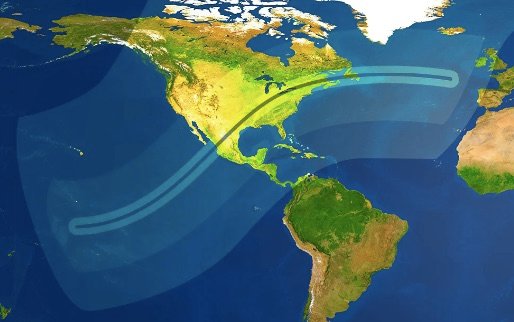
There is certainly no shortage of festivals along the path of totality either. If you have places to be around this area it’s probably a good idea to reschedule, call it a cosmical sign. My partner and I will be attending a festival in Mazatlán, Mexico which I will so eagerly be documenting and sharing with my readers.
Highly populated cities that are in the path of totality are listed below in order from first visible to last:
- Mazatlán, Sinaloa, Mexico
- Torreón, Coahuila, Mexico
- Dallas, Texas, USA
- Indianapolis, Indiana, USA
- Cleveland, Ohio, USA
- Buffalo, New York, USA
- Sherbrooke, Quebec, Canada
- Newfoundland and Labrador, Canada

If you are anywhere in the lighter shaded areas known as the penumbra, a partial eclipse only will be visible. With UV blocking and infrared radiation blocking eye glasses you can still safely marvel at the slight coverage of our giant hot fireball in space. These glasses should be used at all times when looking at the sun, even if you are in the zone of totality also known as the umbra (the innermost and darkest part of a shadow).NASA and ISO-12312-2 recommend a shade of 14 for viewing. To put this into perspective, a welding helmet rarely goes above shade 12 at it’s darkest. So don’t be using your welding helmet unless you can set the shade to at least 12 or higher.
How long will the solar eclipse be visible?
The eclipse will take about two and a half hours with totality being only around 4 minutes and 28 seconds! The closer you are to the eclipse centre line, the longer it will be. But i’m sure it will still feel short, and well worth every second of craning your neck to the sky. The sun will not only burn an image in your cornea, but in your lasting memory as well.
Our Moon and Sun
The moon, 27% the size of our beautiful planet, just big enough to turn out the lights for a moment will turn our attention to it’s magnificence. It is responsible for our tides, for helping migratory birds navigate, and for tuning the cycles of life on Earth. The moon upholds value in cultures around the world for it’s profound effect on our lives, keeping a balance, like the yin to our yang, our moon to our sun. The Sun on the yang side of things shines a brilliance unlike any manufactured item we could ever accomplish, burning gasses visible thousands of light years away. There are 9 TRILLION km’s in a light year, and we are only 149 million km from the sun so we get a great big dose of that beautiful radiant energy.
When our Yin and Yang meet
News of the eclipse will surely be sliding into your DM’s as the Moon slides in front of the Sun. Some awesome eclipse characteristics will be visible to our shaded eye (assuming you are wearing your eclipse glasses) and here is what to watch out for.
The Corona – During the eclipse the outer most layer of the sun’s atmosphere will be visible, it’s called the corona (the white haze around the sun). The corona is primarily made up of ionized gases which are heated to about 1 – 3 million Kelvin (the sun’s actual surface is only 5800 K). How it is heated is still subject to debate but there is some theories that it is due to the sun’s ever-changing magnetic field. A hot mess of MHD waves. The corona is more visible during active periods of the solar cycle and we are nearing the peak, happening in 2025!
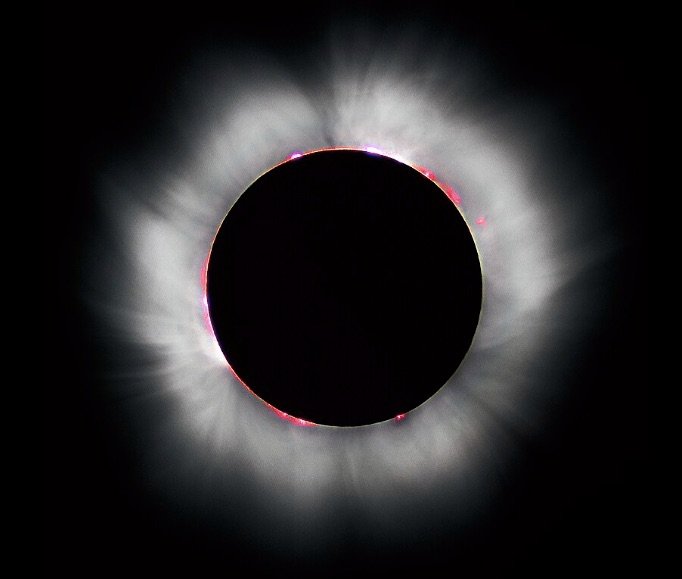
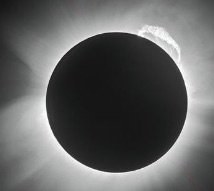
Solar Flares and Coronal Mass Ejections – Since we are nearing the peak of our Sun’s 25th cycle, our chances of seeing a solar flare or CME during the eclipse is greater. Solar flares often follow shortly after CME’s. If one should occur at a 90 degree angle from Earth we could have a spectacular show of magnetic field and plasma. Pushing matter and solar wind across interstellar space.
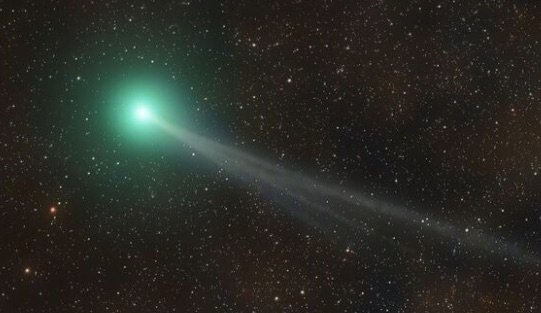
Pon-Brooks Comet (The Horned Devil) – With an orbital period of 71 years, this comet will be nearing the sun right on time for our eclipse. Perhaps even visible in the zone of totality. It was first discovered in 1812 by Jon-Louis Pons and again in 1884 by William Roberts Brooks. This greenish comet is mostly ice and dust. When approaching the sun and perihelion it turns to gas and bursts which led to it’s nickname… The Devil Comet, as it grew what looked like horns trailing behind it.
A Safer Solar Eclipse Experience
This is an experience of a lifetime for sure. So let’s be sure you have these memories for a lifetime! Safety first! Our first time shouldn’t be our last time. So let’s protect those eyeballs with some certified solar eclipse viewing glasses! It’s also worth noting that in the zone of totality there will be an influx of people to catch a glimpse. Please be patient and practice intergalactic kindness during this stellar event. We should revel in this galactic experience and be happy with how small our problems really are. It’s more than a simple blessing that we are apart of such a perfect moment in space and time.
If you liked this article and would like to read more on astronomical chatter, i’ve just begun my journey to achieve amateur astronomer status! Follow my progress by checking out Part I here of a small series i’m doing to help myself and hopefully others in gazing at the stars :).
[…] We’ve reached altitude and our 5 hour journey to Puerto Vallarta starts it’s count down. Some mild turbulence through the troposphere only bothered me a bit. I’m curious to know how the sun is affecting the ionosphere right now. On the last night in our quiet town the skies opened to reveal beautiful twinkling stars, flashing blues and reds, the distance light getting distorted from our atmosphere, our atmosphere distorted from the sun. The Sun is why we are flying to Puerto Vallarta. And not just to lie on the beach basking in it’s rays, but to watch it get covered up by the moon, for the April 8th 2024 Solar Eclipse. […]