Starship’s Third Successful Test Flight (my thoughts and prayers)
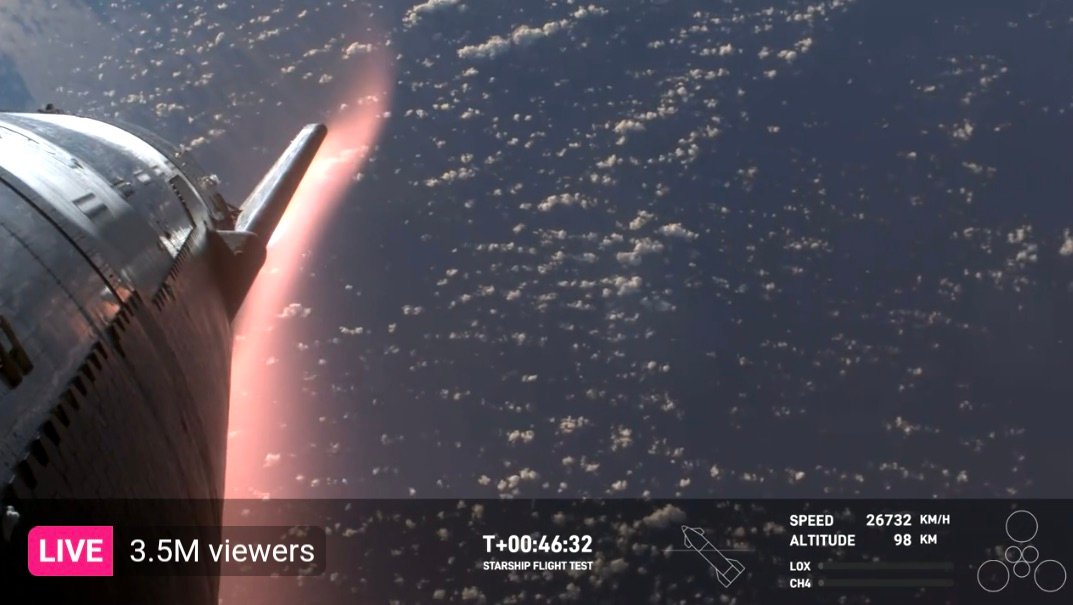
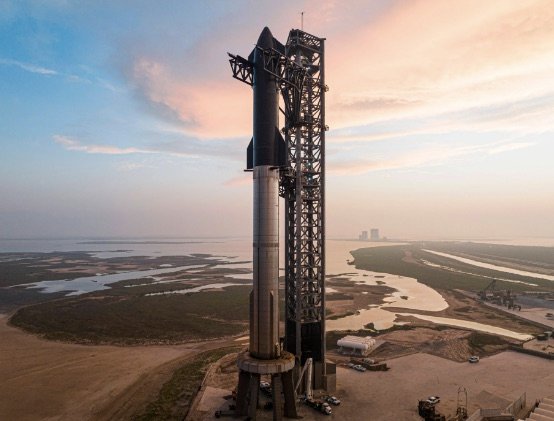
Wouldn’t miss it for a sleep-in
I won’t lie, if it weren’t for taking a melatonin the night before I would have missed the launch entirely. My habitual stress nights and begrudgingly useless mornings are getting to me but thanks to manufactured hormones that come in chewable flavoured candies, I can now force my brain to think it’s time for bed.
To be perfectly honest though I partly missed the launch, but to my luck I managed to scroll onto a news post of a live stream, making my morning daze vanish into a shrill, I tuned in just in time to see Starship soaring through space. Of course I promptly looked outside my window, only to see a thick blanket of cloud overhead. Bummer.
Encountering atmosphere
Seeing the wings’ precise maneuvering, guided by an extensive sensory system for its return back into Earth’s atmosphere was quite awe inspiring, although being lost over the Gulf of Mexico, the fact they made it this far is huge. Speed over ground at the time of re-entry was just under 27,000 km/hr, that’s nearly 22 times the speed of sound! Almost 4 times faster than the fastest recorded jet fighter, ever. Just absolutely sending it on its way back to Earth with orbital speeds. Being confined to our little planet, our atmosphere provides the force that provides and limits us, if left to meander in space, Starship could just continuously soar into the stars to explore new worlds and solar systems happily ever after. But we kind of need that data, not nearly as much as we need our atmosphere, but we’d like to hopefully launch humans one day and bring them back. So yeah, re-entry.
Utilizing what they call an atmospheric break, our ozone entrapping billions upon billions of particles of nitrogen, oxygen and other gasses making the breaking resistance on 5,000 t of stainless steel, fuel and possibly a simulated payload. With this amount of speed slamming all of those particles together and around the surface of Starship, it compressed them together, creating so much heat that most material would just burn up before striking Earth. That is why Starship is equipped with 18,000 silica based hexagonal tiles for heat shields. Most of the flight was transmitted via a camera on the tip of a forward wing (the forward flap camera). I took some screenshots of my favourite moments of re-entry. Just seeing how the atmosphere starts emitting light from the heat of compression around the tiles and wing as it’s making adjustments to maneuver in…so cool!
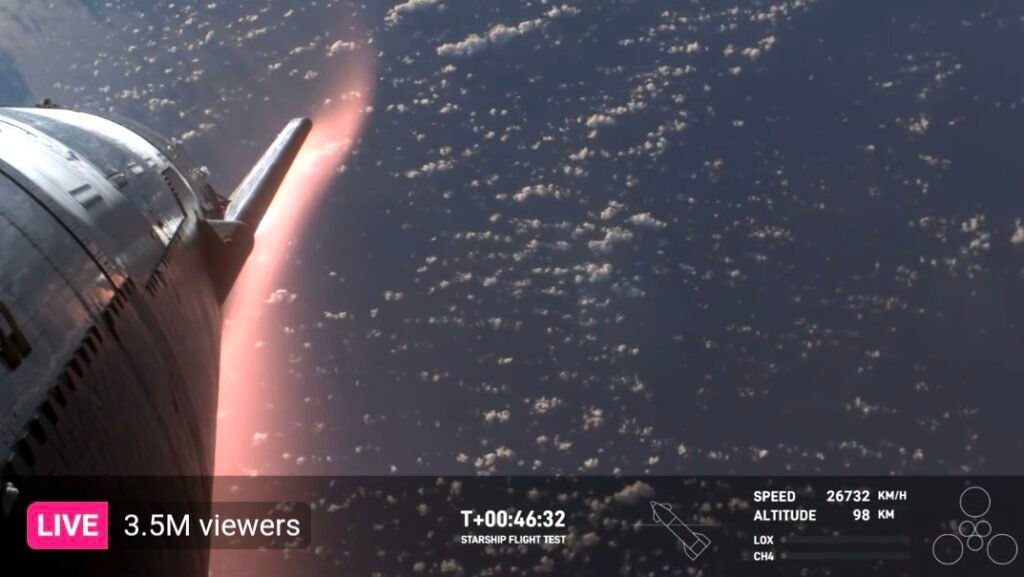
Starship just beginning it’s re-entry into our atmosphere (Earth’s atmosphere doesn’t have a distinct end point so most of the time we just use a delineation known as the Karman Line, about 100 km above Earth’s surface).
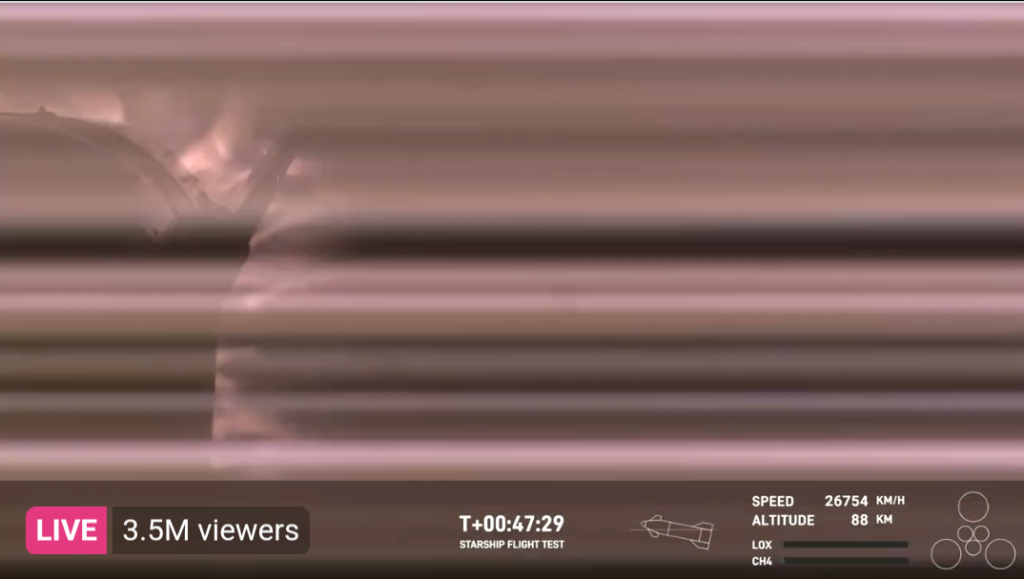
First camera starting to black out and loose signal.
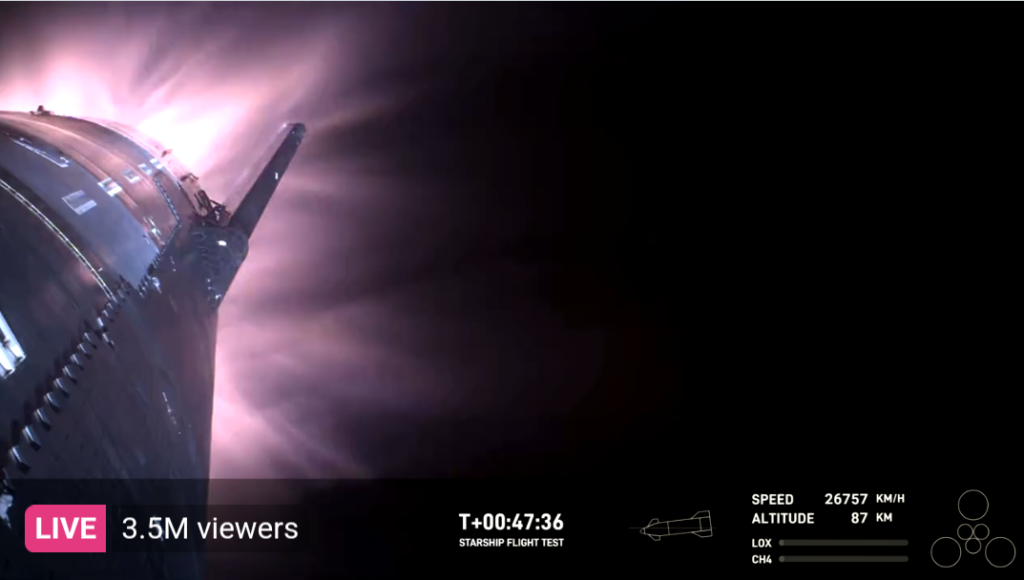
In the thick of it now. Starship is seemingly forcing compression on all areas around it now.
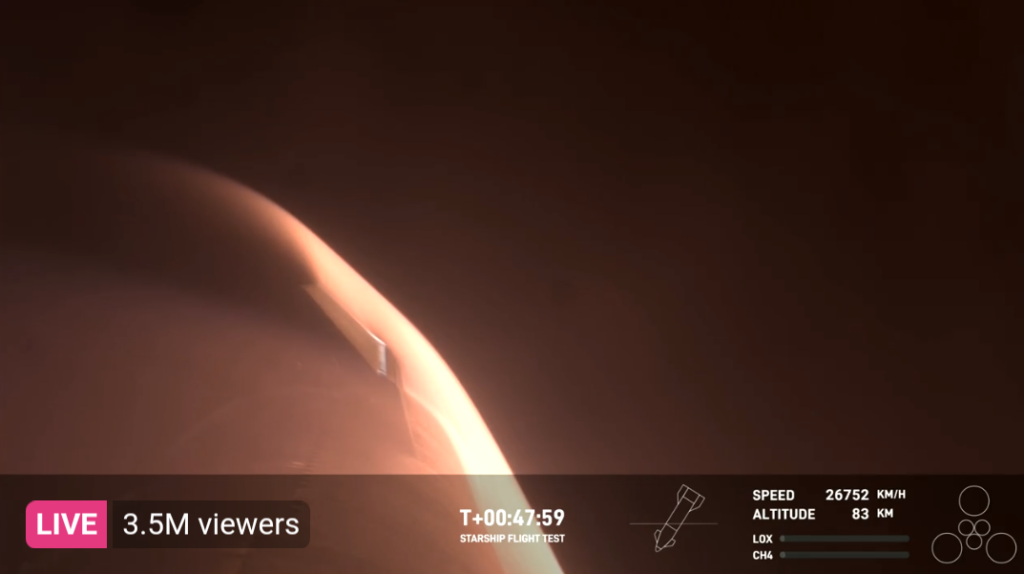
Last screen capture before losing contact. Looks as though the flaps are making a solid effort, forcing heat to affect only hex tiles. But is it enough?
Blasting out of the confines of gravity
After 2 minor/major hiccups (depending on your personal risk threshold) they managed to get the largest rocket ever, to lift off our giant rock and orbit around it for a few minutes. So how did SpaceX manage that? They designed their own engine of course. I’m going to look past burning copious amounts of fuel to launch satellites and say that SpaceX is on the right track to being eco-conscious…reduce, reuse, recycle… right? Oh who am I kidding…it’s way more cost effective!! They’re looking for things that last! So they designed their own rocket engine, calling it the Raptor (Click here for the Wiki page on the SpaceX Raptor, worth a read featuring simple process diagrams). With full-flow staged combustion cycle this rocket works on the principle of similar rocket engines but with two shafts, two turbines and creating a deeper cryogenic (cooled) fuel, making the liquid methane and oxygen propellents denser, meaning more juice per unit of fuel, less starvation at fuel pumps and less likely to cavitate on the turbines and turbo-pumps. Longevity!
To infinity and beyond
So i’m sure everyone has seen Elon Musks “Occupy Mars” shirt. I suppose he works on the principle of “go big or go home” because that there is a massive goal. Kudos to the team at SpaceX and all the power to them though. What they’ve accomplished since their beginnings has transformed space travel completely. I feel incredibly fortunate to be alive during this time as the clock of life never ceases to tick and our saga here on Earth seemingly flickers like a candle running out of wax. The doom of political unrest, war, economical struggles and environmental disasters makes it difficult to find hope for the future. In my small 30 years as a conscious being on this planet, I’m just happy to experience what’s left on Earth and find peace in what dirt and water can bring to life. I hope that when the time comes for a human to step foot on Mars, that they bring with them a philosophy much different than what we have now, but surely that will come naturally. When this beautiful blue planet shrinks in the scope of their porthole and the challenges of a mysterious planet grow large. May my thoughts and prayers find them.
[…] be interested in reading my article on SpaceX’s Third Starship launch – check it out here! Thanks for joining me in my journey to amateur […]